Crude Oil Is Down 32% From Its October High, Diesel Only 11%: The Oil Shock Now Sits in Diesel
- ▸The International Energy Agency's November Oil Market Report (13 November 2026) says global oil supply rose to 105.4 mb/d in October and exceeded demand for the first time since the war in Iran began. North Sea Dated crude fell 32%, from $136/bbl in early October to about $93/bbl.
- ▸Diesel followed only partly. European diesel fell 11% over the same period, to close to $180/bbl, which the IEA puts 77% above pre-war levels; crude is $22/bbl (about 31%) above them. The IEA calls tight supply of refined products, especially diesel, the main worry for the market and consumers.
- ▸EconoLens analysis: on the IEA's figures, about $56 of European diesel's roughly $78/bbl rise since before the war, or around 72%, is the widening gap between diesel and crude, not the crude price itself. So far, cheaper crude has done less for diesel buyers than the crude price suggests.
The International Energy Agency sees tentative signs that the oil market is rebalancing. In its Oil Market Report published on 13 November 2026, the IEA said world oil supply rose by 2.3 million barrels a day (mb/d) in October, to 105.4 mb/d, as exports from the Gulf recovered. For the first time since the war in Iran began, supply exceeded demand, and observed oil stocks rose by 52 million barrels during the month.
Crude prices responded. North Sea Dated crude fell from a high of $136 a barrel on 8 October to about $93 when the report was written, a drop of 32%. Diesel followed only partly. Diesel in Europe fell by 11% over the same period and, at close to $180 a barrel, was still 77% above its pre-war level. Crude was $22, or about 31%, above its own.
That gap is the story of this report. Crude oil is getting easier to buy. Diesel is not, and the IEA says tight supply of refined products, especially diesel, is the main worry for markets and consumers.
What the IEA reported
The supply recovery has been fast. Global output rose by 3 mb/d in September and by a further 2.3 mb/d in October, a gain of 5.3 mb/d since August. Gulf oil exports, excluding Oman, reached 18.4 mb/d in October, still 26% below pre-war levels. Crude led the recovery: Gulf crude flows rose to 15 mb/d, or 82% of their pre-war level.
The recovery is uneven. The IEA says Gulf exports of refined products and liquefied petroleum gas (LPG) remain at roughly half of pre-war levels. It also reports that attacks on Russian energy infrastructure continue to restrict Russia's diesel exports, adding to the losses from the Middle East.
Stocks tell the same story. Oil at sea rose by 86 million barrels in October, to its highest level since January, as Gulf crude was shipped out; that is more than the 52 million barrel rise in observed inventories as a whole. Onshore inventories fell again, to levels not seen since 2016 or earlier. Since the war started, the IEA's count of observed stocks is down 462 million barrels.
Refining, the step that turns crude into diesel, slowed further. Refiners processed 81.3 mb/d in October, 1.3 mb/d less than in September and a seasonal low; the IEA expects runs to recover to 84.7 mb/d in December. It reports weaker refining margins in nearly every region in October, with Asian plants squeezed by record shipping costs.
| Indicator | Figure | Period |
|---|---|---|
| Global oil supply | 105.4 mb/d (+2.3 mb/d on September) | October 2026 |
| Supply increase since August | +5.3 mb/d | August to October 2026 |
| Gulf oil exports excluding Oman | 18.4 mb/d (26% below pre-war) | October 2026 |
| Gulf crude exports | 15 mb/d (82% of pre-war) | October 2026 |
| Change in observed oil stocks | +52 mb (oil at sea +86 mb) | October 2026 |
| Global refinery runs | 81.3 mb/d (−1.3 mb/d on September) | October 2026 |
| North Sea Dated crude | $136/bbl high to about $93/bbl (−32%) | 8 October to time of writing (report of 13 November 2026) |
| Diesel in Europe | close to $180/bbl (−11%; 77% above pre-war) | early October to time of writing (report of 13 November 2026) |
How the IEA sees the next year
The IEA forecasts that world oil demand will fall by 2.7 mb/d in 2026, to 102.3 mb/d, and rise by 2 mb/d in 2027. The year-on-year fall is projected to narrow to 2.7 mb/d in the fourth quarter of 2026, from 5 mb/d in the second quarter and 3.8 mb/d in the third. Demand is expected to return to growth around March 2027.
On supply, the IEA projects a fall of 4.8 mb/d in 2026 and a rebound of 6.6 mb/d in 2027, to 108.1 mb/d, including 5.3 mb/d more from the Gulf. Its balances point to a surplus in the fourth quarter of 2026 and a larger stock build in 2027. These are projections, and the IEA says downside risks remain because attacks on shipping threaten the maritime security on which the recovery depends.
The composition of the demand recovery matters for fuels. The IEA expects LPG, ethane and naphtha, which feed petrochemical plants, to provide close to 80% of the 2027 increase. It expects only a very modest gain in transport fuels, because costly fuel is pushing drivers faster towards electric and more efficient vehicles.
EconoLens Analysis: cheaper crude has not yet meant cheaper fuel
The EconoLens claim is narrow. On the IEA's own price figures, most of European diesel's rise since before the war is no longer explained by the price of crude. It is explained by the gap between crude and diesel, which has widened as crude fell. The IEA does not give the pre-war dates; EconoLens assumes the crude and diesel baselines refer to the same period.
The arithmetic is simple. If crude is $22 above its pre-war level at about $93, it stood near $71 before the war. If diesel at close to $180 is 77% above its pre-war level, it stood near $102. The gap between the two was therefore about $31 before the war, about $66 in early October and about $87 at the time of the report. Of diesel's roughly $78 rise, about $22 reflects dearer crude and about $56, or around 72%, the wider gap.
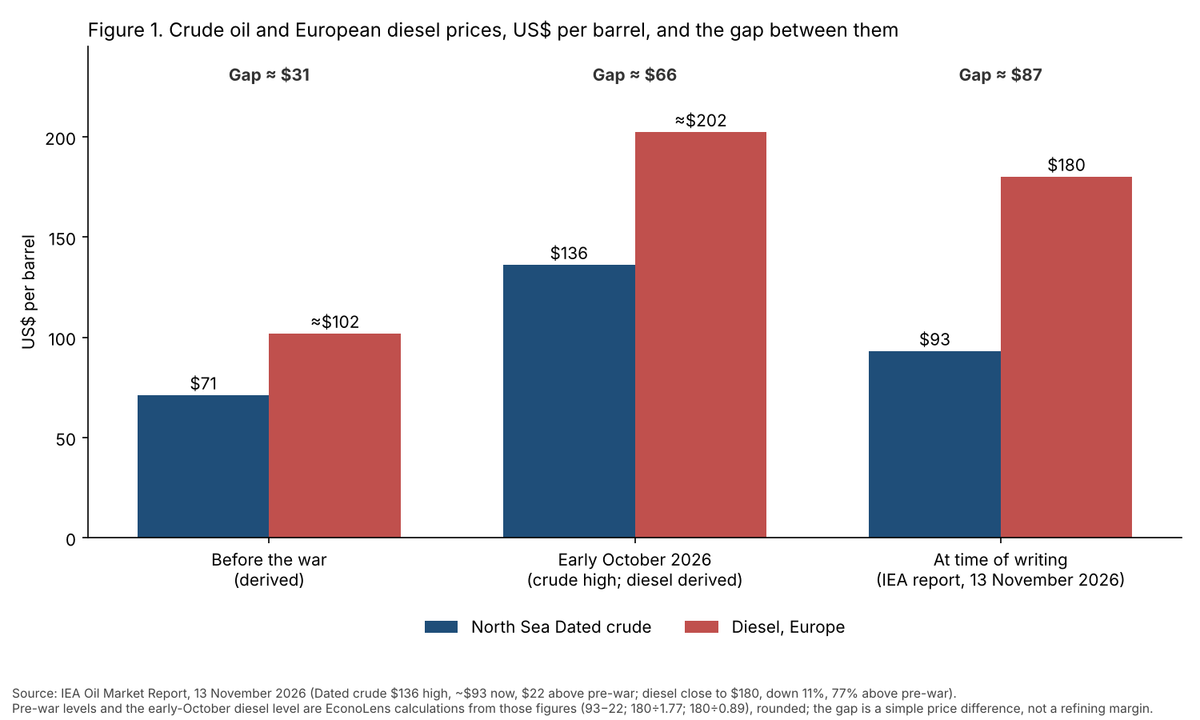
The early-October figure assumes the IEA's 11% diesel fall runs from the same date as crude's 8 October high; the 72% result does not depend on that assumption, and it stays between 71% and 73% if diesel is anywhere from $175 to $185. The result also does not depend on the dollar measure. In percentage terms, crude is about 31% above its pre-war level and diesel 77%. The direction of travel since October also points the same way: crude fell by about $43 a barrel, while diesel, on the IEA's 11% figure, fell by about $22.
There are good reasons not to read too much into this. Crude itself is still $22 above its pre-war level, so it remains part of the problem. Diesel did fall, by 11%. The IEA's Executive Director had already written to member governments on 11 October about tightening diesel markets; the IEA now expects refinery runs to rise by 3.4 mb/d between October and December, and IEA members agreed on 15 October to release more than 20 million barrels of emergency diesel stocks as soon as possible. Our gap is also a simple price difference between two benchmarks, not a refining margin: it includes freight and quality differences that EconoLens has not measured.
So the finding is about where the shock sits now, not how long it will last. In November 2026, on the European benchmark the IEA reports, the remaining burden of the oil shock falls more on buyers of diesel than on buyers of crude, and a falling crude price is, for now, a weak guide to what diesel users pay. EconoLens has not shown the same split for gasoline, jet fuel or diesel outside Europe.
Where the assessments disagree
The IEA's report leans towards rebalancing. Supply is recovering faster than demand, stocks have started to rise, and its balances show a surplus from the fourth quarter. On diesel, it describes emergency stock releases as a "critical bridge" until refining and product output recover, and it notes that Asian refiners may run harder as crude becomes easier to obtain and as China issues fresh product export quotas.
The US Energy Information Administration's Short-Term Energy Outlook of 10 November 2026 takes a firmer view of product markets. It now assumes that global petroleum product markets will face continued supply constraints through the end of 2027. It forecasts Brent near $100 a barrel for the rest of 2026, an average of $86 in 2027 and $77 in the fourth quarter of 2027. Its forecasts are averages over those periods, while the IEA's $93 is a point price at the time of writing, so the two are not directly comparable.
The EIA expects fuel prices to fall in 2027, but by less than crude in percentage terms. It forecasts that Brent will average about 12% less in 2027 ($85.78) than in 2026 ($97.44), while US retail diesel falls about 4%, from $5.25 to $5.03 a gallon. Retail prices include taxes and distribution costs that do not move with crude, and the EIA forecasts a similar 4% fall for gasoline, so this comparison shows slow pass-through to pump prices in general, not a diesel-specific effect.
Global implications
In EconoLens's reading, the most direct effect is on importers of refined fuels rather than importers of crude. The IEA's figures show Gulf product exports at about half of pre-war levels and Russian diesel exports restricted, while crude flows have recovered to 82% of pre-war levels. On that evidence, economies that buy their diesel ready-made are likely to be more exposed than those with spare refining capacity, which can turn cheaper crude into fuel. This is an interpretation, not a measured effect.
Although margins weakened in most regions in October, the IEA reports that refiners in the Atlantic Basin, particularly in the United States, are running hard to capture high margins. For central banks, the Bank of Canada's recent decision and October's rate calls were made against energy price shocks; a fall in crude that does not reach fuel prices would leave the energy component of consumer prices higher than the crude price alone suggests.
What happens next
- Refinery runs: the IEA expects global throughput to recover to 84.7 mb/d in December. If it does, the gap between diesel and crude should start to narrow.
- Emergency diesel: the delivery of more than 20 million barrels of diesel from IEA members' emergency stocks, agreed on 15 October.
- Shipping security: the IEA names attacks on shipping as the main downside risk to its forecast.
- The EIA's next Short-Term Energy Outlook: due on 8 December 2026, according to the EIA's outlook page.
- The IEA's December Oil Market Report: the next monthly update of its balances.
Conclusion
The November Oil Market Report marks a real change in the crude market: supply now exceeds demand and crude has fallen by about a third from its October high. It does not yet mark the end of the shock for fuel users. On the IEA's own figures, around 72% of diesel's rise since before the war is now the gap between diesel and crude rather than crude itself. Until refining output and product exports recover, the crude price is likely to understate what the oil shock is still costing diesel users.
The data and the working
All inputs are from the IEA Oil Market Report of 13 November 2026, except the EIA figures. Calculations were run in Python; rounding is applied once, at the end.
- Pre-war crude: $93 − $22 = $71/bbl.
- Crude above pre-war (%): 22 ÷ 71 = 31.0%.
- Pre-war diesel: $180 ÷ 1.77 = $101.7/bbl (≈ $102). The IEA gives diesel as "close to" $180, so all diesel figures are approximate.
- Early-October diesel: $180 ÷ (1 − 0.11) = $202.2/bbl (≈ $202), assuming the IEA's 11% fall is measured from the same early-October date as crude's high.
- Gap (diesel minus crude): before the war 101.7 − 71 = $30.7 (≈ $31); early October 202.2 − 136 = $66.2 (≈ $66); at the report 180 − 93 = $87.
- Decomposition of diesel's rise: 180 − 101.7 = $78.3 in total; crude's part $22; the remaining $56.3 is the wider gap, 56.3 ÷ 78.3 = 71.9% (≈ 72%). Sensitivity: diesel $175–185 and 76.5–77.5% above pre-war give 71.0–72.8%.
- Falls since early October: crude 136 − 93 = $43; diesel 202.2 − 180 = $22.2 (≈ $22); crude (136 − 93) ÷ 136 = 31.6% (the IEA rounds to 32%).
- Supply recovery: 3 + 2.3 = 5.3 mb/d since August, as the IEA states.
- Refinery recovery: 84.7 − 81.3 = 3.4 mb/d, October to December (IEA forecast).
- EIA (10 November 2026): Brent 85.78 ÷ 97.44 − 1 = −12.0% (Table 2 values); US retail diesel 5.03 ÷ 5.25 − 1 = −4.2%; gasoline 3.73 ÷ 3.89 − 1 = −4.1%.
Simplifications: North Sea Dated crude and European diesel are different benchmarks, with different delivery terms. The gap is a price difference, not a refiner's margin, and EconoLens has not adjusted it for freight or quality.
Related reading
- Brent crude indicator
- Energy prices are forecast to ease in 2027. Food prices are not
- OPEC+ and the new oil order: supply strategy after the Hormuz shock
Sources
- International Energy Agency, Oil Market Report – November 2026, 13 November 2026. https://www.iea.org/reports/oil-market-report-november-2026
- International Energy Agency, IEA Governing Board statement on energy markets and security, 15 October 2026. https://www.iea.org/news/iea-governing-board-statement-on-energy-markets-and-security
- International Energy Agency, IEA statement on responding to the global diesel market situation, 11 October 2026. https://www.iea.org/news/iea-statement-on-responding-to-the-global-diesel-market-situation
- US Energy Information Administration, Short-Term Energy Outlook, November 2026, 10 November 2026. https://www.eia.gov/outlooks/steo/archives/nov26.pdf
- US Energy Information Administration, Short-Term Energy Outlook page (next release date), accessed 19 November 2026. https://www.eia.gov/outlooks/steo/
This article is for information and education only. It is not investment advice or a recommendation to buy or sell any security, commodity or financial product. Prices and forecasts cited are from the named official sources at the dates given and may change. Readers should consult a SEBI-registered adviser before making investment decisions.
This article covers the IEA's global oil market assessment and the crude–diesel price gap; it does not attempt an India-specific assessment, as no official India figure was used.
Frequently Asked Questions
What did the IEA's November 2026 Oil Market Report say?
Published on 13 November 2026, it reported that global oil supply rose to 105.4 mb/d in October and exceeded demand for the first time since the war in Iran began, and that observed stocks rose by 52 million barrels. It forecasts that demand will fall by 2.7 mb/d in 2026 and rise by 2 mb/d in 2027.
Why has diesel fallen less than crude oil?
The IEA points to supply of refined products: Gulf exports of products and LPG are at about half of pre-war levels, attacks on Russian energy infrastructure are restricting its diesel exports, and global refinery runs fell to 81.3 mb/d in October. Crude supply has recovered faster than the capacity to deliver diesel.
How far are oil and diesel prices above their pre-war levels?
At the time of the IEA report, North Sea Dated crude was about $93 a barrel, $22 or about 31% above its pre-war level. Diesel in Europe was close to $180 a barrel, 77% above its pre-war level.
What is the gap between diesel and crude prices, and is it a refining margin?
It is the difference between a diesel price and a crude price, about $87 a barrel at the time of the IEA's 13 November report, on the IEA's figures, against about $31 before the war (EconoLens estimate). It is not a refining margin, because it does not account for freight, quality or the refining yield.
Will fuel prices fall in 2027?
The EIA projects lower prices but continued pressure on fuels: it forecasts Brent at $86 a barrel on average in 2027 and US retail diesel at $5.03 a gallon, and it assumes product markets stay constrained through the end of 2027. These are projections, not outcomes.
Primary Sources
Cite This Article
Khagan Rao. (2026, November 19). Crude Oil Is Down 32% From Its October High, Diesel Only 11%: The Oil Shock Now Sits in Diesel. EconoLens. https://www.econolens.co.in/news/iea-oil-market-report-november-2026-crude-falls-diesel-tight
Khagan Rao is an economist and analyst specialising in global monetary policy, fiscal frameworks, and international trade. He tracks publications from the IMF, World Bank, BIS, and RBI to deliver accessible, data-driven analysis for a global audience.